

How To Edit Services File In Windows 7
Windows 8 Windows viii.i Windows seven Windows Vista Windows XP Windows x More...Less
Summary
This article helps you reset the Hosts file back to the default.
What's the Hosts file
The Hosts file is used past the operating organisation to map human-friendly hostnames to numerical Internet Protocol (IP) addresses which identify and locate a host in an IP network. The hosts file is one of several organisation resources that address network nodes in a estimator network and is a common part of an operating system's IP implementation.
The Hosts file contains lines of text consisting of an IP accost in the first text field followed by ane or more host names. Each field is separated by white space (Tabs are often preferred for historical reasons, merely spaces are as well used). Comment lines may exist included, and they are indicated by a hash character (#) in the showtime position of such lines. Entirely bare lines in the file are ignored.
If the Hosts file is inverse from default, resetting it can help resolve some connectivity issues.
Resolution
To reset the Hosts file back to the default, follow these steps according to your operating organization:
To reset the Hosts file dorsum to the default, follow these steps:
-
Open up Notepad. To exercise this, search for "Notepad" using Cortana, and and then tap or click the Notepad icon.
-
Copy the post-obit text, and then paste the text into the file: # Copyright (c) 1993-2006 Microsoft Corp. # # This is a sample HOSTS file used by Microsoft TCP/IP for Windows. # # This file contains the mappings of IP addresses to host names. Each # entry should exist kept on an individual line. The IP accost should # be placed in the beginning column followed by the respective host proper noun. # The IP address and the host name should be separated by at to the lowest degree one # space. # # Additionally, comments (such as these) may exist inserted on private # lines or post-obit the machine name denoted past a '#' symbol. # # For case: # # 102.54.94.97 rhino.peak.com # source server # 38.25.63.10 x.acme.com # ten client host # localhost name resolution is handle within DNS itself. # 127.0.0.one localhost # ::1 localhost
-
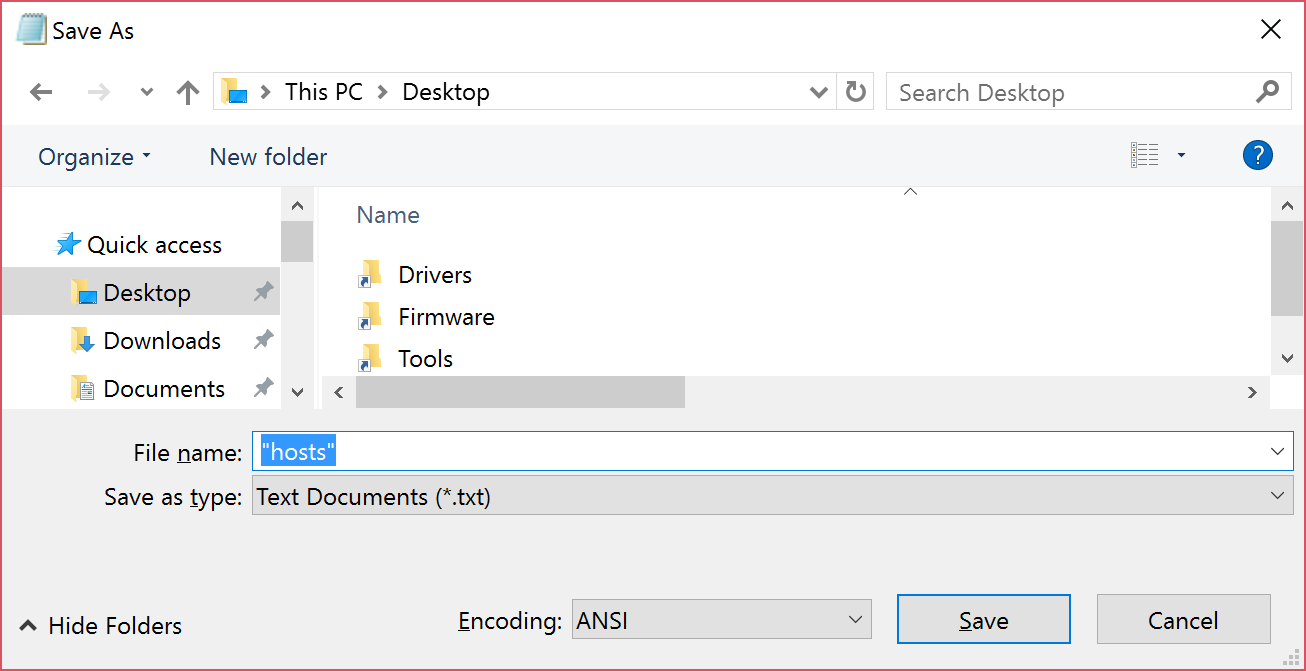
On the File menu, selectSalve as, type "hosts" in the File proper name box (as displayed in the following image), and then save the file to the desktop.
-
Close Notepad.
-
Search for %WinDir%\System32\Drivers\Etc using Cortana, then select the File folder icon.
-
Tap and concur or right-click the Hosts file, select Rename, and so rename the file as "Hosts.old".
-
Copy or move the Hosts file that yous created in step three from the desktop to the %WinDir%\System32\Drivers\Etc binder. If you are prompted to enter an administrator countersign, select Continue.
To reset the Hosts file dorsum to the default, follow these steps:
-
Open Notepad. To do this, swipe in from the right edge of the screen, tap Search, type Notepad, and so tap the Notepad icon. Or, if you lot are using a mouse, indicate to the upper-right corner of the screen, motion the mouse pointer downwards, click Search, blazon Notepad, and then click Notepad.
-
Copy the following text, and and so paste the text into the file: # Copyright (c) 1993-2006 Microsoft Corp. # # This is a sample HOSTS file used by Microsoft TCP/IP for Windows. # # This file contains the mappings of IP addresses to host names. Each # entry should exist kept on an private line. The IP address should # be placed in the first cavalcade followed by the corresponding host name. # The IP address and the host name should be separated past at to the lowest degree one # space. # # Additionally, comments (such as these) may be inserted on individual # lines or post-obit the machine name denoted by a '#' symbol. # # For case: # # 102.54.94.97 rhino.acme.com # source server # 38.25.63.ten x.superlative.com # 10 client host # localhost proper noun resolution is handle inside DNS itself. # 127.0.0.1 localhost # ::1 localhost
-
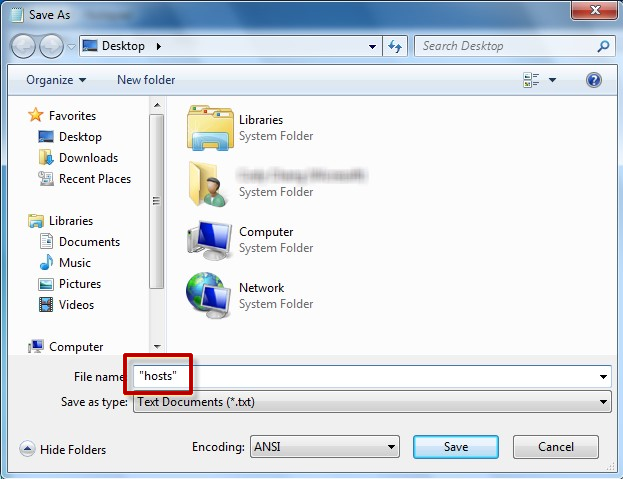
On the File menu, selectSave equally, blazon "hosts" in the File proper name box (as displayed in the following prototype), and and then salve the file to the desktop.
-
Close Notepad.
-
Open up the %WinDir%\System32\Drivers\Etc folder. To do this, follow these steps:
-
Swipe in from the right edge of the screen, tap Search, type run, then tap the Run icon. Or, if you are using a mouse, point to the upper-right corner of the screen, move the mouse pointer down, selectSearch, blazon run, and and then select the Run icon.
-
Type %WinDir%\System32\Drivers\Etc in the Open up box, and so selectOK.
-
-
Select the Hosts file, selectRename, and so rename the file as "Hosts.one-time".
-
Copy or move the Hosts file that you created in stride 3 to the %WinDir%\System32\Drivers\Etc folder. If you are prompted to enter an ambassador password, tap or click Keep.
To reset the Hosts file back to the default yourself, follow these steps:
-
Click Start, click Run, type Notepad, and then click OK.
-
Copy the post-obit text to the file:
For Windows 7 # Copyright (c) 1993-2006 Microsoft Corp. # # This is a sample HOSTS file used by Microsoft TCP/IP for Windows. # # This file contains the mappings of IP addresses to host names. Each # entry should be kept on an individual line. The IP address should # be placed in the kickoff column followed past the respective host proper noun. # The IP accost and the host name should be separated by at least one # space. # # Additionally, comments (such equally these) may be inserted on individual # lines or post-obit the machine name denoted by a '#' symbol. # # For example: # # 102.54.94.97 rhino.top.com # source server # 38.25.63.10 x.superlative.com # x client host # localhost name resolution is handle within DNS itself. # 127.0.0.1 localhost # ::ane localhost For Windows Vista or for Windows Server 2008 # Copyright (c) 1993-2006 Microsoft Corp. # # This is a sample HOSTS file used by Microsoft TCP/IP for Windows. # # This file contains the mappings of IP addresses to host names. Each # entry should be kept on an private line. The IP address should # be placed in the beginning column followed by the corresponding host proper name. # The IP address and the host name should exist separated by at least ane # space. # # Additionally, comments (such as these) may exist inserted on private # lines or post-obit the car proper name denoted past a '#' symbol. # # For example: # # 102.54.94.97 rhino.acme.com # source server # 38.25.63.10 x.meridian.com # ten client host 127.0.0.1 localhost ::1 localhost For Windows XP or for Windows Server 2003 # Copyright (c) 1993-1999 Microsoft Corp. # # This is a sample HOSTS file used by Microsoft TCP/IP for Windows. # # This file contains the mappings of IP addresses to host names. Each # entry should be kept on an individual line. The IP address should # be placed in the get-go column followed by the respective host proper name. # The IP address and the host proper name should be separated by at to the lowest degree 1 # space. # # Additionally, comments (such as these) may be inserted on individual # lines or post-obit the machine proper name denoted past a '#' symbol. # # For example: # # 102.54.94.97 rhino.height.com # source server # 38.25.63.10 x.elevation.com # ten client host 127.0.0.1 localhost
-
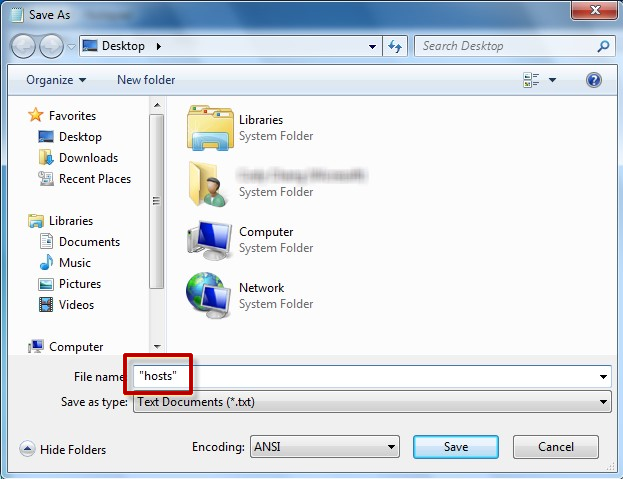
On the File menu, selectSalve equally, type "hosts" in the File name box, and then save the file to the desktop.
-
SelectOffset >Run, type %WinDir%\System32\Drivers\Etc, and then selectOK.
-
Select the Hosts file, and rename it "Hosts.old."
-
Copy or move the Hosts file that you created in step 3 to the %WinDir%\System32\Drivers\Etc binder. If you are prompted to enter an administrator password, selectKeep.
More Data
Back up for Windows XP has concluded
Microsoft ended back up for Windows XP on April 8, 2014. This change has affected your software updates and security options. Acquire what this means for you lot and how to stay protected.
Support for Windows Server 2003 ended on July 14, 2015
Microsoft ended support for Windows Server 2003 on July 14, 2015. This change has affected your software updates and security options. Larn what this means for y'all and how to stay protected.
Source: https://support.microsoft.com/en-us/topic/how-to-reset-the-hosts-file-back-to-the-default-c2a43f9d-e176-c6f3-e4ef-3500277a6dae
Posted by: martinezlech2001.blogspot.com
0 Response to "How To Edit Services File In Windows 7"
Post a Comment